
More Than Just a Happy Dog
I simply felt like walking.
Sometimes I think we forget how lovely that can be.
No destination. No step count to beat. And my watch not telling me I was somehow behind schedule. Just a walk because…well…I felt like it.
The tide was on its way out, children were building sandcastles that would almost certainly disappear before lunchtime, and there were the usual collection of people wandering along the shoreline. Some walked with purpose, as though they were training for the Olympics. Others wandered at the sort of pace that suggested they’d already figured out one of life’s biggest secrets—that not every walk needs to achieve something.
I’ve always liked that second group.
As I wandered along, I noticed an older gentleman walking towards me with what could only be described as an extremely enthusiastic Labrador.
You know the sort.
The kind of dog whose entire body wags instead of just the tail. Every wave was fascinating. Seagulls looked highly suspicious. And every shell required immediate investigation. If another dog appeared in the distance, it was clearly the best thing that had happened all week.
If joy could grow fur, I suspect it would look exactly like that dog.
It Seemed Like a Good Idea at the Time
What really caught my attention, though, wasn’t the Labrador.
It was what he was carrying.
A stick.
And not just any stick.
A stick the size of a small tree. Honestly, I wasn’t entirely convinced it hadn’t originally belonged to a council landscaping project.
The poor dog was absolutely determined to carry it, despite the obvious fact that it was several sizes larger than he was.
Every few metres the end of the stick would dig into the sand, bringing him to an abrupt halt. He’d stop, look down at it with complete confusion, as though wondering who on earth had put that obstacle there, then back up a few steps and try again.
For a few glorious seconds it would work perfectly.
Then…
THUD
Straight back into the sand.
He Wasn’t Giving Up
If it wasn’t catching in the sand, it was wedging itself between clumps of seaweed. If it escaped the seaweed, it would clip the edge of the dunes. Every now and then he’d give it an extra enthusiastic tug, convinced that a little more determination would somehow change the laws of physics.
It never did.
What made me laugh was that he didn’t seem remotely discouraged. There wasn’t the slightest hint of frustration. No dramatic sigh. No giving up. He simply approached the whole thing as though this latest setback had absolutely nothing to do with the previous one.
“Oh…that didn’t work.”
Reverse.
Tilt the head.
Try a slightly different angle.
Charge forward again with complete confidence.
Watching him was like watching someone trying to manoeuvre a king-size mattress through a single doorway. The optimism was impressive. The success rate…not so much.
I found myself quietly willing him to succeed.
Come on, mate, I thought. This one might work.
By this stage I was smiling to myself, and when I looked up, his owner had that wonderfully familiar expression that every Labrador owner seems to wear—a mixture of affection, resignation and the quiet acceptance that logic had long ago packed its bags and moved out.
It Was Worth One More Try
His owner caught my eye and shook his head with the sort of smile that suggested this wasn’t their first disagreement over an oversized stick.
“I’ve told him three times that’s too big,” he said.
I laughed.
“I’m guessing he doesn’t take advice particularly well.”
The gentleman chuckled.
“No,” he replied. “He likes to learn these things for himself.”
We stood there for another minute watching this wonderfully stubborn Labrador continue negotiating with a piece of timber that had absolutely no interest in cooperating.
Every time the stick caught in the sand, he’d stop, stare at it as though completely baffled by the situation, then back up a few steps and try again. He’d tilt his head, shuffle sideways, give it another determined tug and somehow seem convinced that this attempt was going to be different.
It never was.
Then, quite suddenly, he stopped.
Without the slightest bit of drama, he let the enormous stick fall to the sand. He wandered a few metres further along the beach, spotted another stick about half the size, picked it up as though it had been his plan all along, and trotted off with that wonderfully satisfied Labrador grin.
Honestly, it was as if the first stick had never existed.
No disappointment.
His Ego wasn’t bruised.
No standing there wondering whether he should have tried just one more time.
He simply found one that worked and carried on enjoying his morning.
I smiled, wished the gentleman a lovely day and continued on my walk.
But for some reason, I couldn’t stop thinking about that Labrador long after I’d left the beach.
The Weight We Never Meant to Carry
There’s probably a lesson in that somewhere.
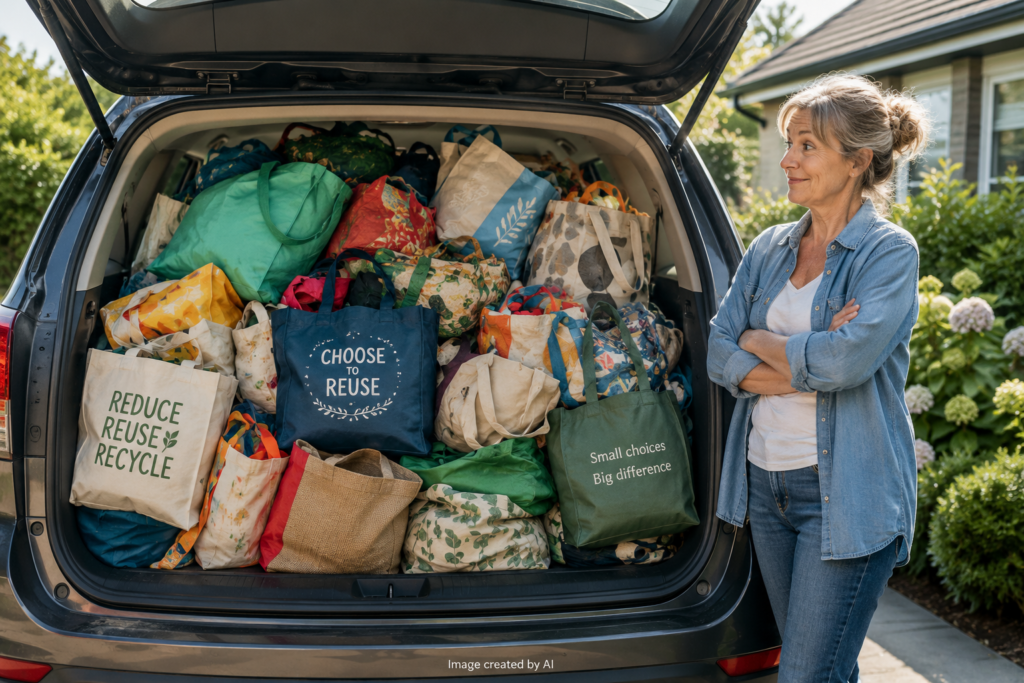
Not because I wander around beaches carrying oversized sticks. Although, if we’re talking about reusable shopping bags, I probably own enough to survive a plastic bag ban until the year 2050.
No, what stayed with me was something else entirely.
I recognised that feeling.
Not the stick.
The weight.
That strange way we humans become so used to carrying something heavy that, after a while, we don’t even think to ask ourselves whether we still need to be carrying it at all.
Have you ever noticed how quietly that happens?
We don’t usually wake up one Tuesday morning and suddenly think, “Right…today I’m officially overwhelmed.”
Life’s a bit sneakier than that.
It starts with one thing.
A friend asks for a favour.
Mum needs a little more help.
Someone leaves work, so everyone else chips in “just for a little while.”
I’m always a little suspicious when someone says something is only temporary.
Temporary has a funny habit of settling in, making itself comfortable and celebrating birthdays.
Then another thing comes along.
And another.
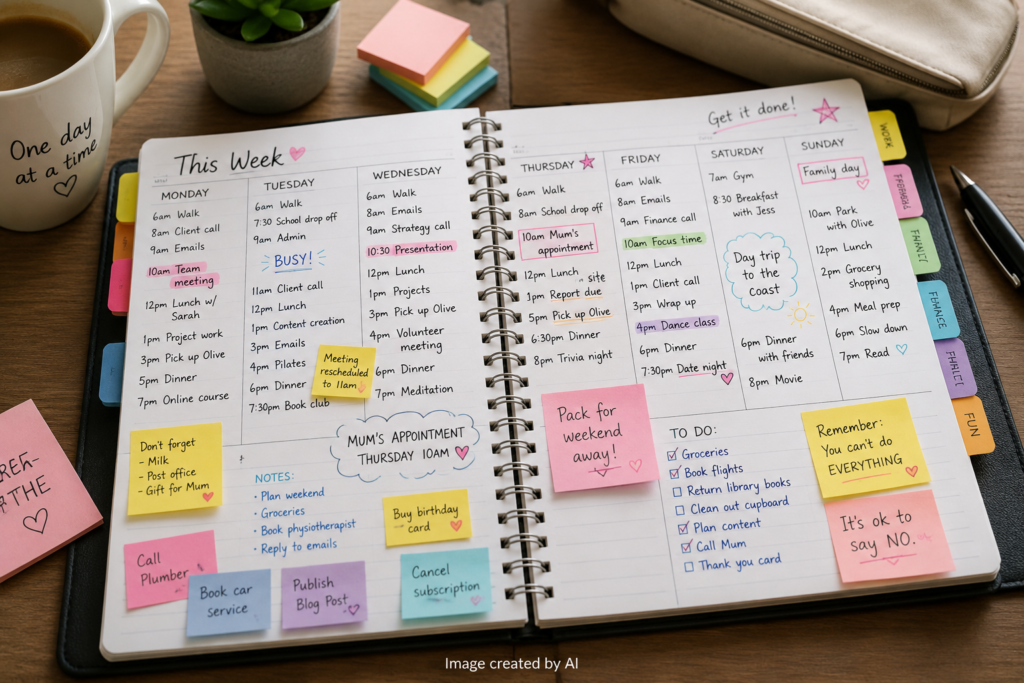
Before you know it, you’ve somehow become the person everyone depends on.
You’re the organiser.
The problem solver.
The emergency contact.
The family diary.
The one who remembers birthdays without Facebook reminding you.
The one who knows exactly where the spare batteries are…and, for reasons you’ll never understand, where the warranty papers for the toaster have been hiding since 2017.
Honestly, if your family were a small business, your job title would probably be Chief Operations Manager.
The Problem With Being Reliable
The funny thing is…
Most of us don’t resent it.
Not in the beginning.
In fact, if we’re really honest, there’s a part of us that quite likes being the dependable one.
It feels good to be trusted.
It feels good to know people can count on us.
There’s something really satisfying about being capable.
I don’t think there’s anything wrong with that.
Until one day you’re standing in the supermarket staring at the yoghurt cabinet, wondering whether you came in for milk…or toothpaste…or stamps…or perhaps to solve the cost-of-living crisis.
You laugh.
“I must be getting older.”
Maybe.
Or maybe you’ve simply been carrying so many things for so long that your brain has quietly decided it’s running out of shelf space.
When Your Body Starts Whispering
I was reading something by Gabor Maté recently, and one of the things I really love about his work is that he reminds us our minds and bodies aren’t operating as separate departments. They’re having the same conversation all day, every day.
That made me stop and think.
Because I wonder how many of us spend years listening to our calendars while completely ignoring our bodies.
Our diaries tell us we’re coping.
Our bodies quietly disagree.
The funny thing is, they don’t usually start shouting.
They whisper.
You don’t sleep quite as well as you used to.
Suddenly, you find yourself getting irritated by things that never normally bothered you.
You walk into a room and suddenly have absolutely no idea why you’re there. After standing for a moment you hope the reason will magically come back to you, and when it doesn’t, you wander into another room convinced that might somehow help.
You feel exhausted after what was, on paper at least, a perfectly ordinary day.
Find yourself snaping at someone you genuinely love and then immediately wonder where that came from.
On their own, none of those things seem particularly unusual.
After all, everyone forgets things sometimes.
Everyone has bad days.
Everyone gets tired.
But what if they’re not completely random?
“What if they’re your body’s quiet way of saying something isn’t working anymore?”
Not dramatic.
Not a crisis.
Just a quiet little nudge saying…
“This stick is getting heavier than you realise.”
Your Body Is On Your Side
I read something else that really fascinated me.
I found that fascinating because our bodies are actually incredibly good at handling short bursts of stress.
When you think about it, it’s actually a brilliant system.
Our heart beats a little faster. Our breathing changes without us even thinking about it. Hormones like cortisol give us the energy to deal with whatever is right in front of us.
The problem is, those systems were never designed to stay switched on all the time.
It’s a bit like driving your car with your foot resting on the accelerator every minute of every day.
Eventually, something would complain.
I sometimes wonder if our bodies are exactly the same.
Not because they’re working against us.
Quite the opposite.
Perhaps that’s what I found so comforting.
Our bodies aren’t trying to make life difficult.
They’re not trying to work against us.
Quite the opposite.
They’re quietly doing everything they can to keep us going.
Sometimes, those restless nights, aching shoulders or moments of forgetfulness aren’t signs that our bodies have given up.
Maybe they’re simply asking us to put one of the sticks down for a while.
Maybe It’s Time to Choose Another Stick
I’ve thought about that Labrador more times than I care to admit.
Not because he was particularly clever.
Not because he was trying to teach anyone a life lesson.
He was simply a happy dog on a beach who discovered that one stick made life much harder than it needed to be.
The thing that stayed with me wasn’t that he chose the biggest stick in the first place.
I think we’ve all done that.
What stayed with me was how easily he let it go.
There was no dramatic farewell.
No standing on the beach wondering whether he’d somehow failed.
No spending the next twenty minutes looking back at the stick he’d left behind.
He simply dropped it, picked up another one that suited him much better and carried on enjoying his morning.
What Balance Really Looks Like
I wonder when we humans stopped being able to do that.
Somewhere along the way we’ve convinced ourselves that putting something down means we’ve given up.
That asking for help somehow makes us weak.
That saying no is selfish.
That if we’re not carrying everything, perhaps we’re not doing enough.
But what if none of that is actually true?
What if wisdom isn’t about becoming stronger so we can carry even more?
What if it’s about recognising which sticks are actually ours to carry…and which ones we’ve simply picked up because they happened to be lying there?
I’ve realised something about the people I admire most.
They’re still kind and generous.
They’re still the people you’d call in the middle of the night if you really needed someone.
But they’ve also learnt something that the rest of us sometimes forget.
They know they don’t have to carry every stick on the beach.
Maybe that’s what balance looks like.
Not caring less.
Not becoming harder.
Simply choosing what really matters.
As I think back to that morning now, I can’t actually remember whether the tide ever came all the way in.
I can’t remember where the children built their sandcastles.
I don’t even remember where I parked the car.
But I can still picture one very happy Labrador trotting along the beach with a stick that finally fitted.
And every now and then, when life starts feeling just a little heavier than it should, I find myself smiling and asking one simple question.
“Am I carrying the right stick?”
Perhaps that’s why dogs always seem to enjoy the beach more than we do.